It is no secret that I love Simple Abundance, both in the original 1997 version and the updated for the new millenium 2019 version. I have them in hardback/paperback and Kindle copy, and one or other of them is a regular go-to when I need a little lift. I met one when I was a new Mother, freshly left alone with a crying baby and in need of a reminder that this, too, will pass and then the updated version as Menopause hit full blast and I needed a reminder, yet again, that change is as natural to a woman’s body and life as breathing, and that inevitably we need to embrace it and accept alterations.
I regularly try to spend a year reading each meditation on the right day, and fail because I don’t keep to timetables well, or I haven’t read a chunk for a month and then climb on again. It doesn’t matter. Although I would suggest the book is best read in order and at the relevant times of year, it’s also possible to read many of the passages out of sequence (especially on a repeated read) and as and when you need them, not when they were dated. I’d also suggest picking one version (1997 or 2019) and sticking with it, as the dates and topics differ in each one. May 19th in the updated version, for instance, is entitled Sacred Spaces, while in the 1997 version the idea of a Sacred Space surfaces on February 28th and is a lot more practical advice on setting up a personal altar for prayer and contemplation. It’s frustrating, especially if you’re discussing with a friend and don’t clarify which version you’re using, but it does mean there are so many more and different passages to read and enjoy than before.
All of which is basically a digression from the point of today’s post, which is that since Simple Abundance (1997) I have been keen on having a small spot in the house that is my own personal Sacred Space. You can trace my own spiritual journey by what I’ve had there, whether I was more Nature-driven or exploring the role of the Divine Feminine within my faith or, as now, whether my Christian faith was most dominant in my heart and mind. Actually, I’m doing the Divine Feminine a disfavour there, because she’s still very much present with me in the form of a lot of Marian/Mary Magdalene/Women of the Bible focussed study and worship. The men might have led the Organized Religions for such a long time, but they never quite managed to get rid of the need for a feminine, loving, nurturing, welcoming side.
Kathryn Robyn describes her vision of sacred space as “you mean it is special to you in an intrinsic way; maybe it helps you feel more whole.” It could be, she argues, a Church, a temple, a mountain grove. I like to think of it as a place where I can feel secure, grounded, surrounded. I have found sacred spaces in the hills of Wales, in front of springs of living water in Cheshire, by the sea any where, but I also need that little spot at home, available to me daily.
In 1997 Simple Abundance, the quote SBB uses to explain a sacred space is from Joseph Campbell: that “You must have a room or a certain hour of the day or so where you do not know what is in the morning paper… a place where you can simply experience and bring forth what you are, and what you might be…” That definitely makes me think of a space that is readily accessible!
My current dedicated Sacred Spaces lie next to my armchair in the living room and next to my bed. Both places I spend a lot of time reading, listening, thinking and praying. They bookend my life, because I sip my morning chai in one spot and my evening mug of sleepy time herbal tea in the other. And I use each for different purposes.


My morning space is a head-clearing place, a chance to meet with God, to read either a passage from the Bible or a book, devotional or commentary. I keep my bible studies and my current Bible on a shelf there, along with two statues of Mary that remind me that *even God* needed use of a real woman’s body to be born incarnate. The shelf holds them together, easily accessible, and in the morning I need little more than my highlighters and a mug of herbal tea to get started.
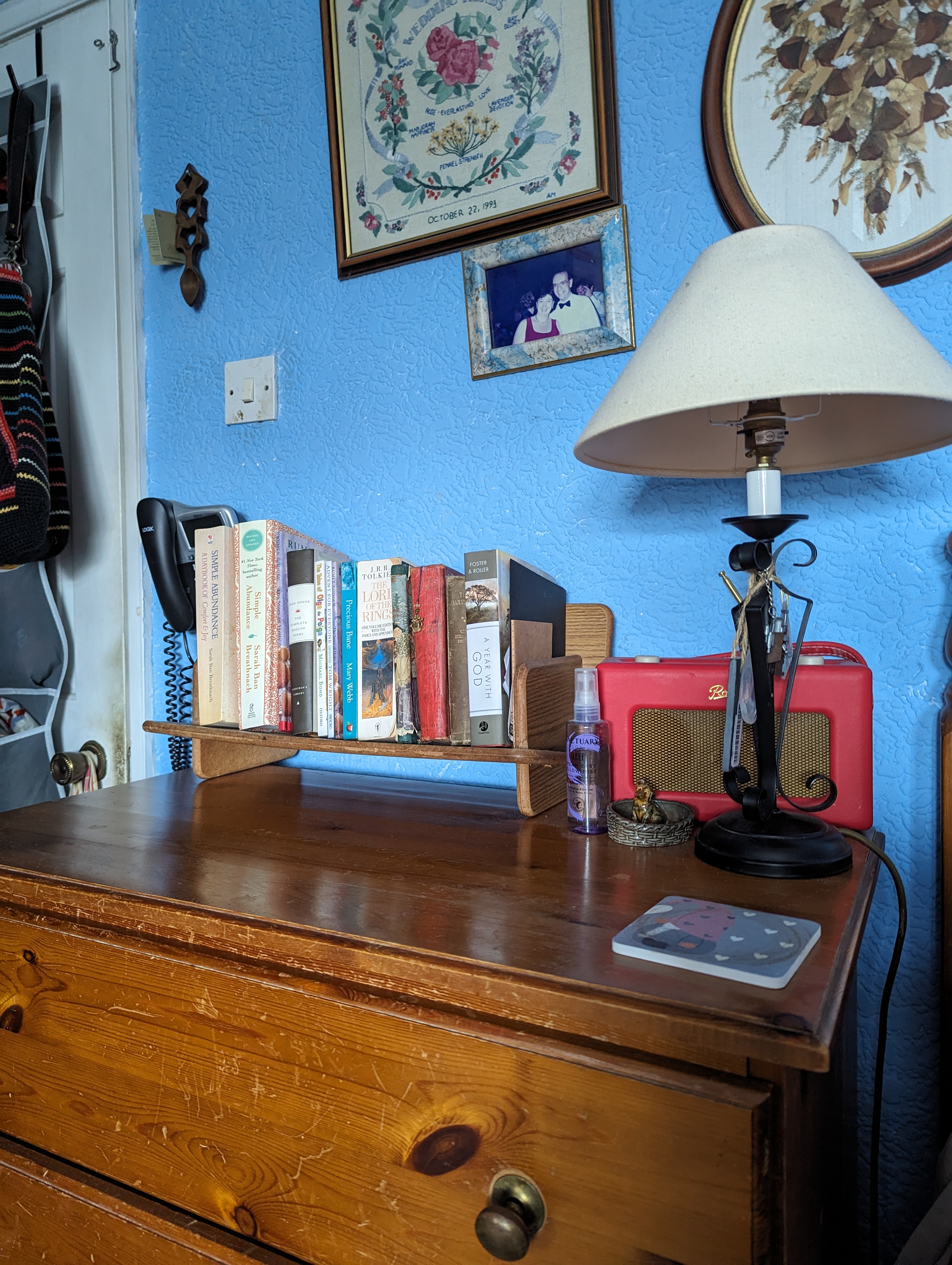

My evening space is in a state of recreation. I polished my bedside table with proper beeswax polish last week and I have just not put anything there yet, not my little rocks, no mat, no models or icons, quotes, cards or anything other than a shelf with the most meaningful books I own. These are the books that have been with me throughout my adult life: a copy of Jane Eyre off my Grandmother, my mother’s ex-library copy of The Harvester, my personal copy of The Lord of the Rings and (of course) both versions of Simple Abundance. I’m keeping the space clear for the moment, and seeing what (if anything) I want to put there as a focus or whether the wood, the space, the symbolism works better for thinking. My evening reading is mostly novels or the current non-fiction I’m working through, but read on my tablet or Kindle rather than hard copy. It may stay clear or I may find the small picture gifted me on my Holy Communion, the rocks from holidays that remind me of family and love, or create a new focal area with found gifts from Nature, snapped up trinkets from travels or gifted memories and inherited treasures.
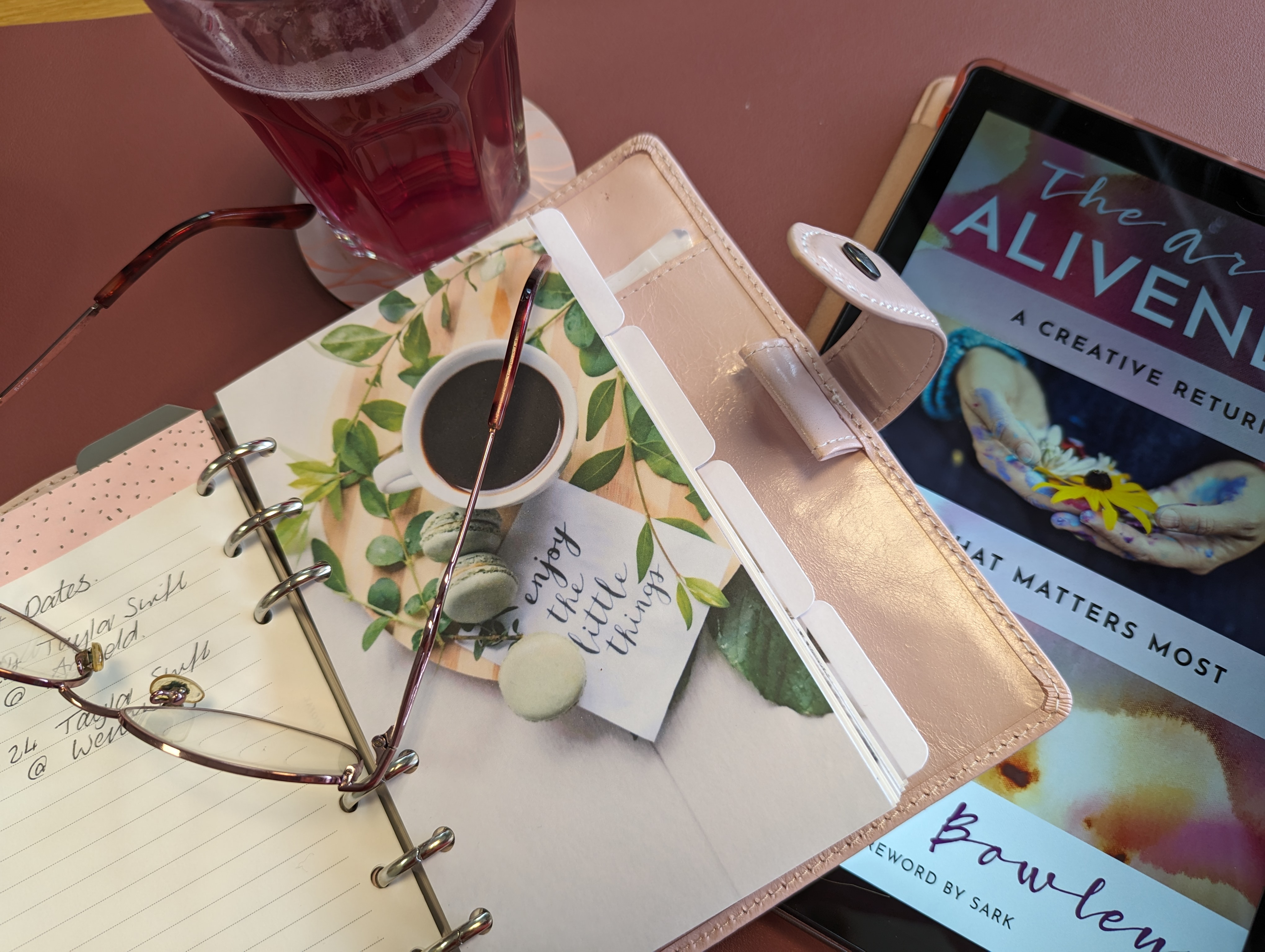
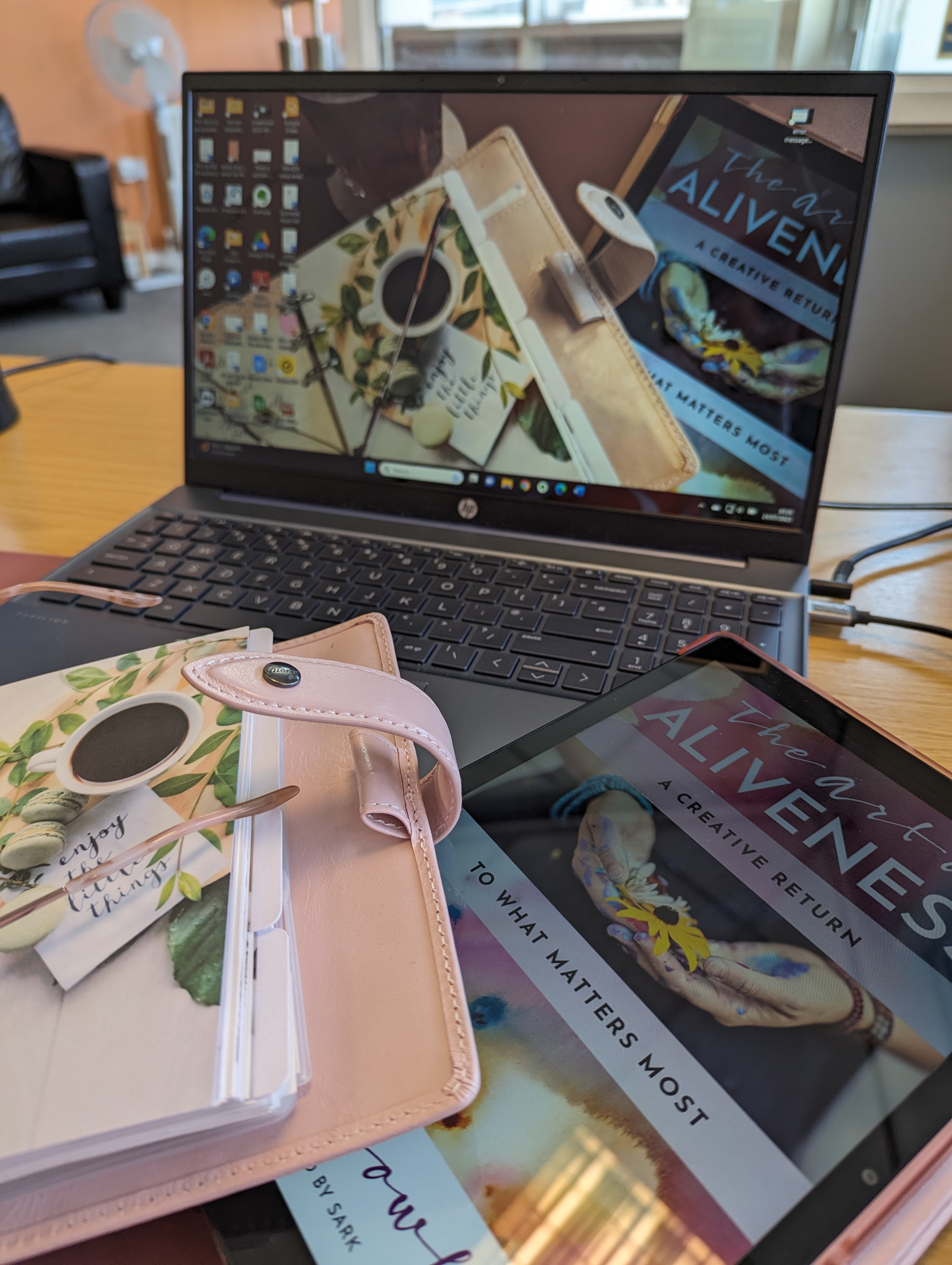
I suppose my final sacred Space is actually the home screen of my work computer or phone. Occasionally in work I feel the need for a headclear. I change the wallpaper on the computer regularly, sometimes to a seasonal picture, sometimes to a special place or holiday shot. At the moment it’s my planner and my reader. A chance to clear my head onto a blank page, reminders to enjoy the little things and inspirational words from people who’ve lived well themselves. The benefit of having a Sacred Space wallpaper is that you always have a breathing place with you, no matter where you are. Chance to reconnect, to ground, to centre oneself and regain equilibrium after the chaos of the outside world, even when you are, physically, right in that maelstrom and will shortly need to step back into real life and assume the Superhero cape.

The unifying aspect of all three is that an outsider, entering into my home, would not immediately look at the spaces and see them as sacred. They possibly wouldn’t mean anything to the people I share home with, at least not until they realised that the junk they left there always gets cleared, that the spaces are clean and that I seem happier and more composed after I’ve sat there quietly than before.
Thinking of setting up your own sacred space? These are my best words of advice:
- It doesn’t need to be sacred to anyone but you, so focus on choosing the objects/items/books that speak to you.
- A sacred space doesn’t need to be a massive feature, or dominate a room. Both of my physicasl spaces are little more than a4 size across or high.
- Don’t grab everything and set it up on a whim. Both SBB and I have found that mulling it over, keeping an eye out for inspiration and collecting the constituent parts slowly over time will create a more meaningful space to use as an altar.
- Don’t be embarrassed to show what you believe. If you’re a Christian, then put a Bible there. If you’re a Pagan then use what makes you happy. If you have no faith, then concentrate on what you do believe in, whether that’s love, happiness or abundance in material and emotional ways.
- Candles are a quick and easy way to create focus. The flame is so primeval, so intrisic to our survival and development as civilised beings. And, of course, they create warmth as well as awareness. A simple tealight is enough, or perhaps a church pillar candle on a stand. I love that I have a collection of votive candles, brought back by my Mother from her holidays in France, and each dedicated to a different Saint of the region.
- Have materials nearby to capture thoughts or prayers on, especially if your sacred Space is public and you (like me) very rarely get a long time alone to pray or study. Catch the thought or prayer on a mind dump page and return to it later if you need to.
- Sacred Space can be merely a time rather than a location. As with the computer wallpaper, it doesn’t need to be 3d if you don’t have any physical space. Just take a moment where you are to breathe, to close your eyes and imagine a space that is sacred for you.
Do you already have a sacred space dedicated to your needs? What’s it like? I know Hindus and Buddhists are encouraged to have sacred spaces within their homes, especially if they live too far from a temple to visit often, but Christian families often don’t get encouraged to create a family sacred space. I also know and believe that all spaces can be sacred, and often the most mundane place is where you need to meet your God/dess most, but focus matters in life, and having a place set aside is, a bit like God telling Moses to remove his shoes as he approached the Burning Bush, a reminder that Man was made to seek out the Sacred and that it needs respect and our full attention to prosper us.

How to Hygge the British Way is my gift to the world. I don’t get paid for writing it, I’m not in it for the kudos, financial rewards, to become an influencer, work with brands or otherwise make any money from the blog. That’s why there are no ads, and any products I mention and recommend have either been gifted to me or bought by me with my everyday wages or donations from supporters. Every book I review has been bought and read by me, unless stated otherwise.
I do get a couple of pennies each time someone buys from the Amazon links on my page, as an Amazon Affiliate, but otherwise if you’d like to support me, I like to give something back in return. That’s why I write books. It always feels good if you get a book back in return for some money. You can find a full list of my books at my Author’s Page on Amazon, but especially recommended for this time of year are:
Cosy Happy Hygge: Setting up a rhythm to life and rituals to enjoy it to make for a more balanced life that handles waves and storms better. Lent is a season of rituals and resets. The book has small and easy ways to make your life flow with grace and happiness, which lead to more hygge.
Happier: Probably my most personal book, it’s the story of how I used hygge and the little things in life to help boost my happiness. I still go back and reread to remind myself what I need to do to be a happy human. And it’s always the little things.
How to Hygge Your Summer is my book about making the most of summertime. Hygge is so often seen as a winter pastime, and yet the principles of hygge (good food, good friends, time to be) are just as applicable to days when you can gather in a park or garden as when you gather round the fireplace. This book only scrapes the surface of what you can do, but hopefully sends you off with inspiration to make your own summer hygge.
I’m currently working on two book projects: I have a hankering to rewrite 50 Ways to Hygge the British Way, so it’s not available at the moment, but even dearer to my heart and my next stated aim is to finish and publish my next book, Simple Plus Cosy = Hygge. It will be about homemaking and how the home we create shapes the hygge we have. Hopefully it will be finished by the end of summer/autumn/winter.
If you’d like to support me, but don’t want to buy a book, I have a Paypal.Me account as Hygge Jem. Every little helps, so even a few pence goes towards the books, goods and courses I use and recommend on the site. I’m grateful for every little bit that brings me closer to my dream of full-time writing, and I know I couldn’t still be writing if it weren’t for the support of many readers and friends out there. Thank you all for every little bit of support, emotional, physical and financial, you give me.
If you’ve enjoyed this article, don’t forget to share it or save it so others can enjoy reading, thinking about and living hygge as well.
The photo between post and promotions is by Arno Smit on Unsplash. I wish I had a garden shed like this one! I chose it because I love the colours of the windowframes, the tantalisingly inviting open door and the comfy chair within. Perfect spot for a cup of tea and a good book. And the header today is my laptop wallpaper in virtual and reality!
 How to Hygge the British Way